Preface
There is a difference between understanding a principle and being changed by it.
Most modern writing on Japanese concepts is fast, flattened, and too eager to turn a living tradition into a handful of slogans. A difficult idea becomes a social media caption. A practice forged over years becomes a productivity trick. A state cultivated through pressure becomes a mood.
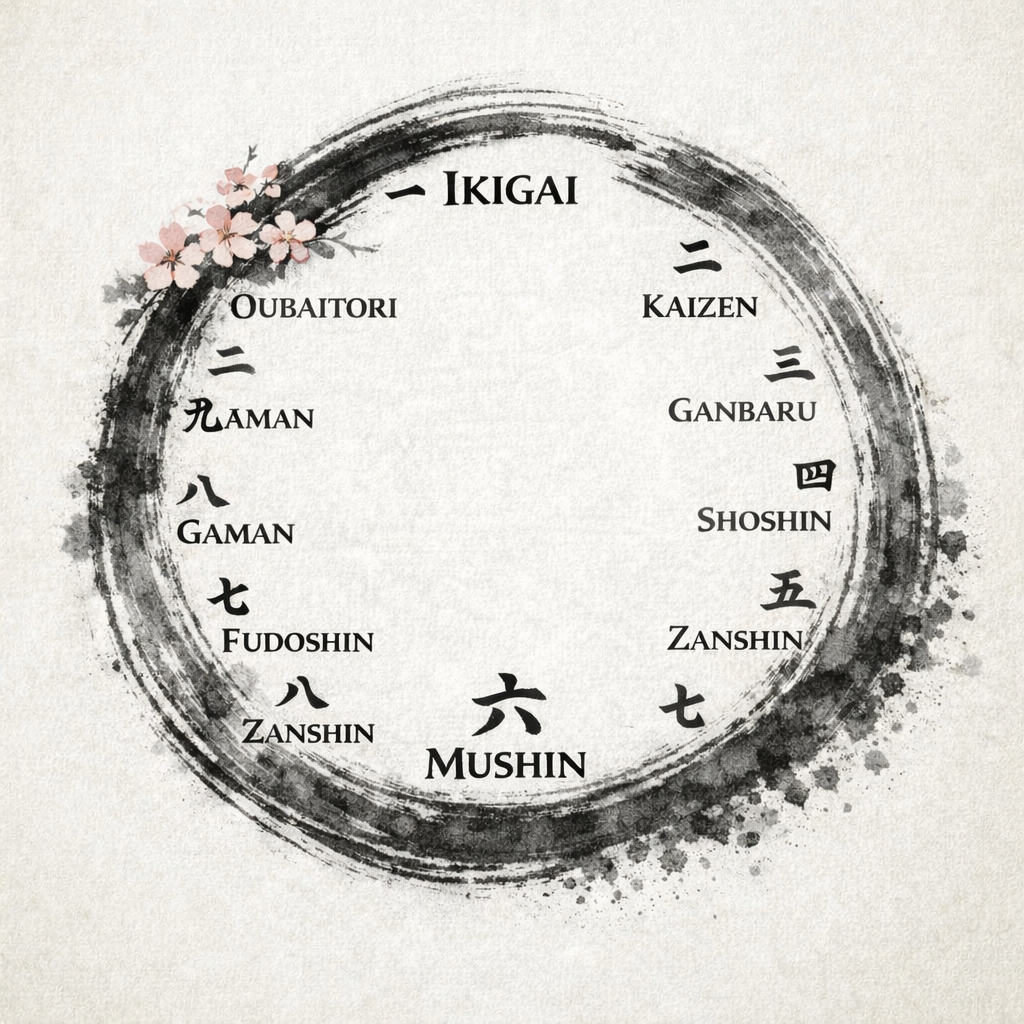
That reduction is understandable. Modern life rewards speed, novelty, and simplification. But it also creates a particular problem for serious practitioners: it makes us mistake recognition for realization. We hear the words mushin, shoshin, ikigai, zanshin, kaizen, and fudoshin, and because they are familiar, we assume we have absorbed them. Yet in the dojo and in life, familiarity is often the enemy of depth. A term can feel known long before it has become embodied.
This book takes the opposite approach. It is not meant to be scanned once, admired, and placed on a shelf. It is meant to be returned to. It is meant to function more like kihon than commentary: repeated, re-entered, and refined over time. Some chapters can be read in a single sitting. Others should be worked through slowly, with notes, drills, and application. The goal is not to collect ideas. The goal is to create an operating system.
A dojo operating system is not software. It is the architecture of conduct. It is the way a practitioner organizes attention, action, recovery, restraint, repetition, and meaning. It governs how one enters the room, how one listens, how one trains when tired, how one reacts when criticized, how one handles boredom, how one returns after failure, how one teaches juniors, how one faces aging, and how one behaves when no one is watching. The dojo operating system is not merely about fighting skill. It is about the continuity between formal training and ordinary life.
That continuity matters. There are many people who can behave with focus for ninety minutes inside a training hall and then immediately become scattered, reactive, and indulgent in the parking lot. There are people who can bow with sincerity, speak reverently of tradition, and still live in a state of distraction and complaint. This is not a moral failure so much as a structural one. They have techniques, but not integration. The point of the old concepts is precisely that they do not end at the wall of the dojo. They become meaningful only when they travel.
This book is therefore built in layers.
The first layer is philosophical orientation. We will explore the concepts themselves, not as museum pieces but as living lenses: ikigai as continuity of purpose, oubaitori as freedom from corrosive comparison, kaizen as compounding refinement, ganbaru as effort without emotional bargaining, wabi-sabi as usable imperfection, shoshin as disciplined openness, mushin as non-clinging action, zanshin as remaining awareness, fudoshin as stable mind under pressure, and gaman as endurance with dignity.
The second layer is technical application. Each concept will be translated into dojo reality: kihon, kata, pad work, sparring, correction, fatigue, injury modification, teaching, rank, etiquette, and recovery. This matters because abstract philosophy often dies when it never enters contact with friction.
The third layer is transfer. The same principles that matter in formal training also govern professional work, relationships, leadership, health, aging, and personal conduct. If the principles are real, they must survive contact with the rest of life.
The fourth layer is practice design. A concept without a drill tends to remain a preference. A principle without a habit remains inspirational language. For that reason, the later chapters include rituals, exercises, journals, breath work, weekly structure, and a 12-week progression so the material can be lived.
One note is important from the beginning. This is not a scholarly attempt to define the “one true” meaning of each Japanese term across all schools, eras, and lineages. These words have histories, nuances, and interpretive ranges. Some are aesthetic terms later adapted into broader self-development language. Some belong to Zen discourse and later migrated into martial arts teaching. Some are modern popularizations. Where helpful, source notes are included at the end. But this is not a philological project. It is a practitioner’s manual.
Another note: this book is deliberately written for someone who trains seriously. That does not mean you need to be young, elite, or competitive. It means you respect pressure, repetition, and form. It means you are willing to practice when there is no applause. It means you understand that maturity in martial arts is not measured only by what happens in combat, but by the quality of your conduct over time.
For an advanced practitioner, the deepest challenge is rarely learning another idea. It is removing interference. The body often knows more than the mind allows it to express. The right action is delayed by tension, ego, haste, doubt, fatigue, vanity, comparison, or overthinking. The point of this book is therefore not to decorate the mind with concepts. It is to strip away what obstructs direct practice.
If that stripping away occurs, a great deal changes.
Training becomes less dependent on mood.
Correction becomes less threatening.
Progress becomes less theatrical.
Discipline becomes quieter.
Attention becomes more continuous.
Purpose becomes less dramatic and more durable.
And the person you are in training begins to resemble the person you are everywhere else.
That is the standard.
Return to this book the way you return to the floor: with respect, curiosity, and a willingness to begin again.
◆ ◆ ◆